Tibial Cortex Transposition (TCT)
A minimally invasive bone surgery that triggers the body's own angiogenesis — regrowing blood vessels into the foot without grafts, implants, or a revascularizable target.
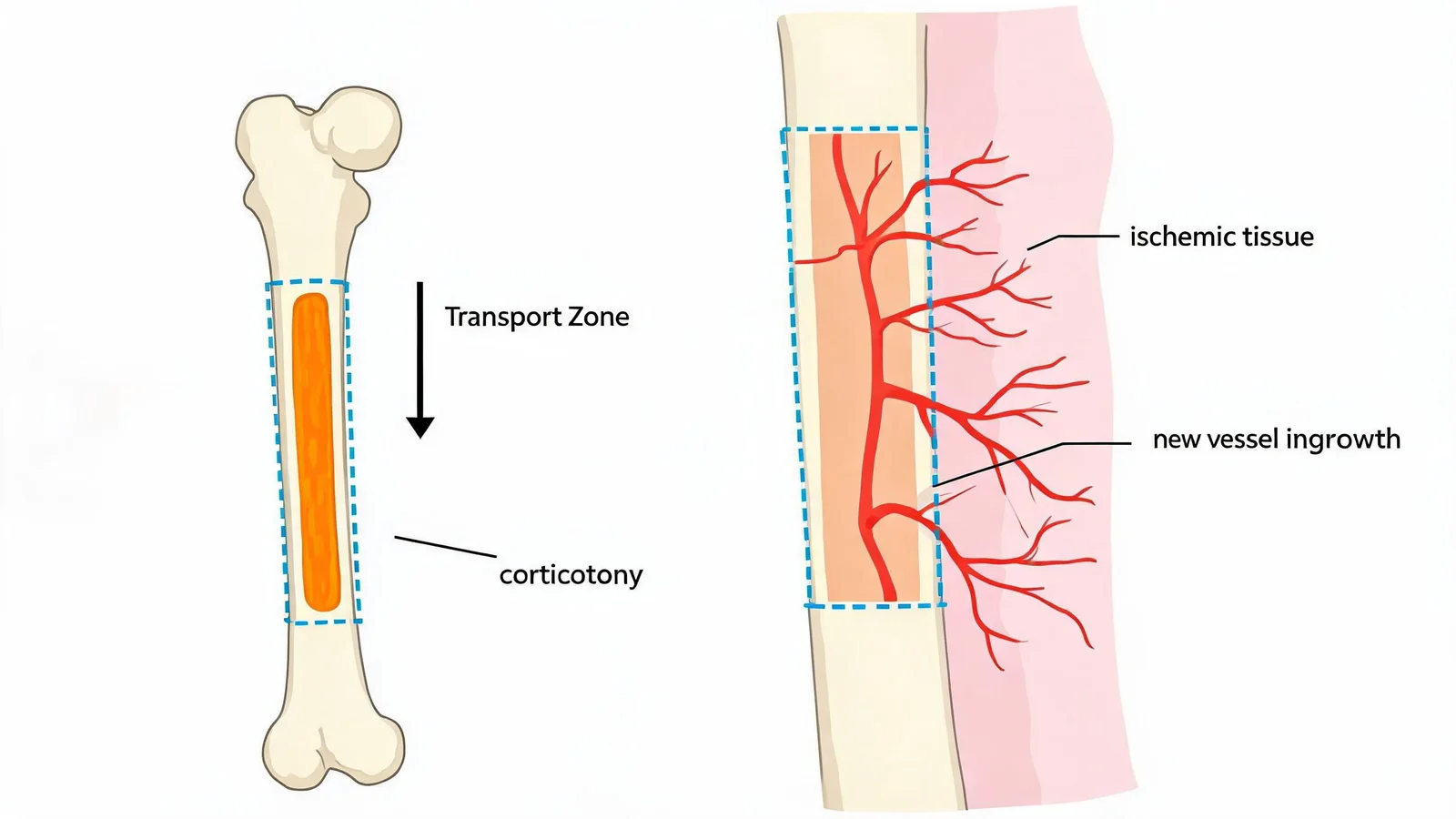
Patients with "no-option" critical limb ischemia (CLI): severe ischemic diabetic foot ulcers where revascularization is not technically feasible and major amputation is being considered. TCT is suitable when imaging shows no revascularizable target vessel and conservative care has failed.
Tibial Cortex Transposition (TCT) is a bone surgery that stimulates the formation of new blood vessels — angiogenesis — in an ischemic foot without placing a bypass or reopening a blocked artery. It is the treatment of choice for patients whose imaging shows no revascularizable vessel and who face major amputation as the only remaining option.
How it works
TCT adapts the Ilizarov principle of distraction osteogenesis. A segment of the tibial cortex (the outer bone shell) is carefully elevated and then slowly transported — a few millimetres per day — by an external fixator. This controlled mechanical stress triggers the release of angiogenic growth factors (VEGF, bFGF) along the transport track, stimulating capillary ingrowth into the ischemic tissue of the foot.
- A 6–8 cm tibial cortex segment is osteotomized under general or regional anaesthesia
- An external fixator is applied; cortex transport begins at day 5–7 post-surgery
- Transport rate: approximately 1 mm/day, over 4–8 weeks depending on lesion severity
- Angiogenesis into the foot is confirmed by skin temperature monitoring and TcPO₂ measurement
Recovery
Patients remain ambulatory with the fixator in place. Wound care continues in parallel. The fixator is removed after the transport phase (typically 8–16 weeks). Foot temperature and perfusion are monitored throughout; ulcer closure is tracked weekly.
Compared to other options
Unlike bypass surgery or angioplasty, TCT does not require a target vessel. Unlike amputations, it preserves the limb. For patients in the "no-option" category, it is often the only technique that can change the disease trajectory.
TCT is a Chinese orthopedic innovation adapted from the Ilizarov distraction-osteogenesis principle. Rather than reopening a blocked artery, it stimulates angiogenesis through controlled bone-cortex movement — so it works even when there is no revascularizable target. Clinical adoption in the US and Europe is nascent; most Western vascular surgeons are unfamiliar with the protocol. Our partner centers have a dedicated TCT surgical team with over 200 performed cases.