Hyperbaric Oxygen Therapy (HBO)
Diabetic foot ulcers fail partly because wound tissue is oxygen-starved. At 2.0–2.4 ATA breathing 100% oxygen, dissolved plasma oxygen reaches ischemic tissue that red cells cannot supply. China's centers run high-capacity multiplace chambers with DFU-specific protocols.
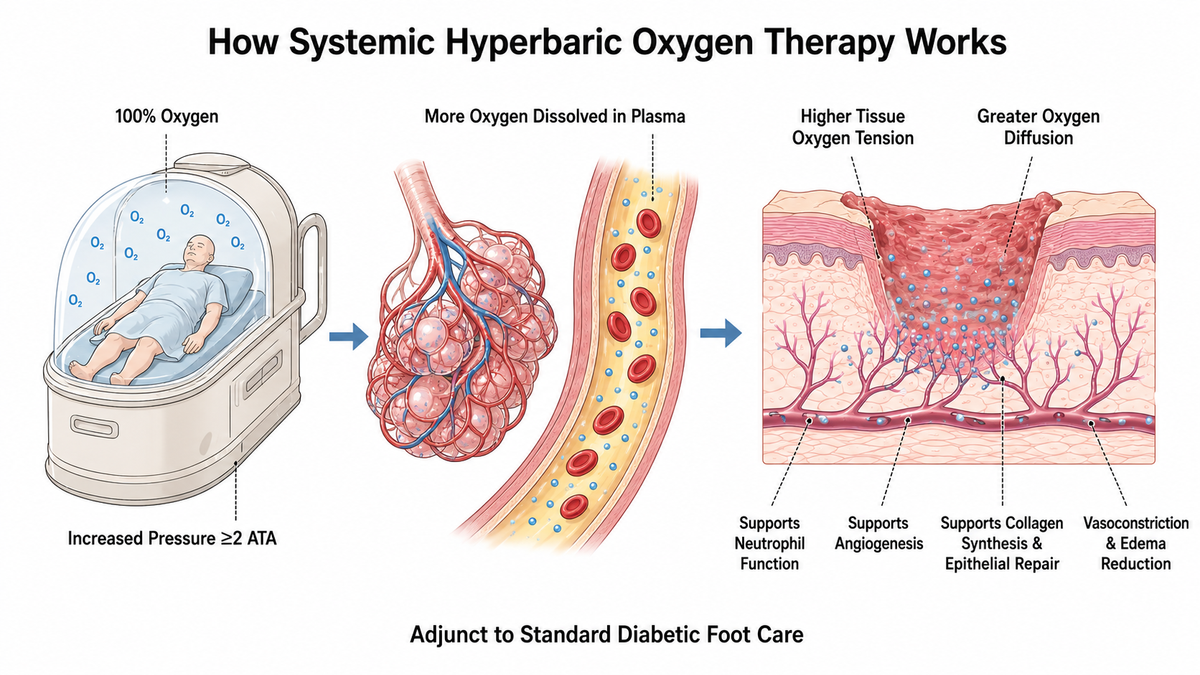
Hyperbaric oxygen therapy addresses one of the fundamental barriers to DFU healing: wound hypoxia. Under normal atmospheric pressure, hemoglobin carries most of the body's oxygen. At 2.0–2.4 ATA while breathing 100% oxygen, enough oxygen dissolves directly into plasma to reach ischemic tissue that compressed or diseased blood vessels cannot supply. China's specialist centers operate large multiplace chambers with protocols developed specifically for the diabetic foot.
Four overlapping mechanisms
- Tissue oxygenation — plasma-dissolved oxygen diffuses into hypoxic wound tissue, restoring the oxygen gradient that drives fibroblast activity, collagen synthesis, and epithelial migration; TcPO₂ typically rises 3–5 fold during a session
- Angiogenesis — repeated cycles of hyperoxia create an oxidative stress gradient that upregulates VEGF and HIF-1alpha, stimulating new capillary formation into the wound bed over the treatment course
- Antimicrobial effect — high oxygen tension is directly bacteriostatic against anaerobic organisms common in deep DFU infections; HBO also enhances the oxidative burst of neutrophils
- Oedema reduction — hyperbaric hyperoxia causes reflex vasoconstriction, reducing oedema without reducing tissue oxygen delivery, since plasma-dissolved oxygen more than compensates for narrowed vessels
Standard DFU protocol
Partner centers follow a DFU-specific protocol: 2.0–2.4 ATA pressure, 90 minutes per session (including compression and decompression phases), five days per week. A full course is 20–40 sessions — minimum 20 for DFU, extended to 40 for osteomyelitis or severe ischemia. TcPO₂ is measured before treatment begins and repeated at session 10 to confirm tissue response; non-responders are re-evaluated for vascular reconstruction.
China's capacity advantage
Where the NHS wait for HBO referral for DFU is often 8–16 weeks and US centers are typically limited to single-occupancy chambers, China's major DFU centers operate large multiplace chambers (8–12 person capacity) running multiple daily sessions. This eliminates the waiting-list bottleneck and allows an intensive course of 20–40 sessions in 4–8 weeks. Medical staff enter the pressurized chamber with patients — enabling clinical monitoring throughout each session for patients with cardiovascular instability or severe wounds.
HBO units exist at many Western hospitals but are typically single-occupancy monoplace chambers with limited throughput; the NHS wait for DFU HBO referral is often 8–16 weeks. China's major DFU centers operate large multiplace chambers (8–12 person capacity) running multiple sessions per day. For patients traveling for treatment, a full 20–40 session course can be completed in 4–8 weeks without waiting-list delay. Staff enter the pressurized chamber with patients — enabling clinical monitoring throughout each session.
References
- Löndahl M et al. Hyperbaric oxygen therapy facilitates healing of chronic foot ulcers in patients with diabetes. Diabetes Care. 2010;33(5):998-1003.
- Kranke P et al. Hyperbaric oxygen therapy for chronic wounds. Cochrane Database Syst Rev. 2015;(6):CD004123.
- Huang ET et al. A clinical practice guideline for the use of hyperbaric oxygen therapy in the treatment of diabetic foot ulcers. Undersea Hyperb Med. 2015;42(3):205-247.
What does this cost?
All-in costs at China's specialist DFU centres — including inpatient stay, procedures, and coordination — are typically far lower than equivalent private care in the US, UK, or EU. Most patients self-pay; we also support insurance reimbursement documentation. We provide a transparent itemised estimate before you commit to anything, at no charge.
Request a free cost estimate →Free medical record review
Share your diabetic foot ulcer records for a free specialist review. Our care coordination team responds within 24–48 hours with an honest assessment.
This website provides medical-information science popularization only. It does NOT provide online diagnosis, prescriptions, or medical advice. Consult a licensed physician for any medical decision.