Maggot Debridement Therapy (MDT)
Sterile Lucilia sericata larvae selectively digest necrotic tissue while leaving healthy tissue intact — providing precise enzymatic debridement with antimicrobial secretions that disrupt biofilm no antibiotic can reliably penetrate.
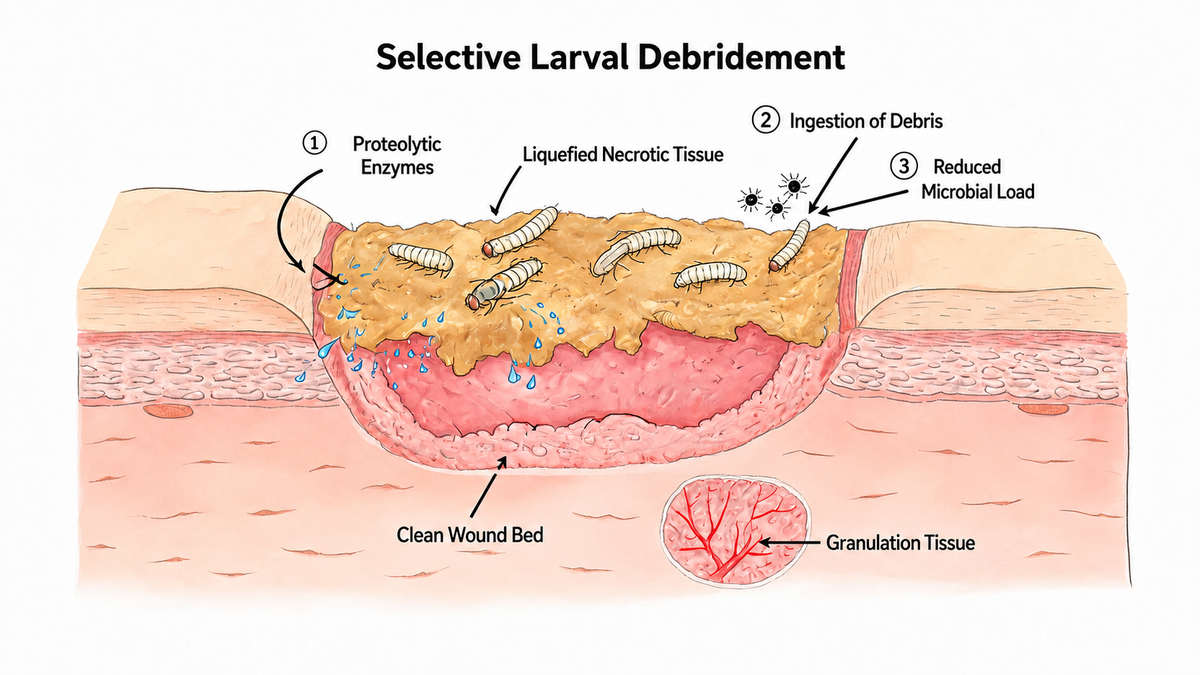
Maggot debridement therapy (MDT) involves placing sterile, medically-produced larvae of Lucilia sericata — the greenbottle fly — directly into a wound. Contained in a mesh biobag dressing, the larvae digest necrotic tissue and secrete antimicrobial compounds while leaving healthy tissue intact. China's specialist DFU centers use MDT routinely as a first- or second-line debridement option, particularly for wounds carrying multidrug-resistant organisms.
Three mechanisms of action
- Selective enzymatic debridement — larval serine proteases and collagenases liquefy necrotic tissue without attacking live tissue, achieving a precision that surgical blades cannot match
- Antimicrobial secretions — allantoin, phenylacetic acid, and defensin-like peptides (MAD-1, MAD-2) demonstrate in-vitro activity against MRSA, Pseudomonas aeruginosa, and ESBL-producing organisms
- Healing stimulation — larval secretions stimulate fibroblast migration, increase keratinocyte activity, and polarize macrophages toward the pro-healing M2 phenotype
Clinical evidence
The Dumville et al. RCT (BMJ, 2009; n=267) found MDT achieved significantly faster time to a clean wound bed versus hydrogel debridement in venous leg and diabetic foot ulcers. A 2020 meta-analysis in International Wound Journal pooling 8 RCTs (715 patients) found that MDT significantly reduced amputation incidence (OR 0.43, 95% CI 0.21–0.88) versus conventional debridement — the most clinically meaningful finding in the literature.
Patient experience
Larvae are contained in a biobag dressing and secured with a retaining bandage; there is no open larval exposure. Some patients report a mild tickling sensation during the first 24 hours; others report nothing. Each application lasts 3–5 days before the dressing is removed, the wound photographed and measured, and a fresh application placed if needed. A typical course is 2–4 applications over 1–2 weeks, after which the wound is reassessed for grafting or secondary closure.
Why China uses MDT routinely
China's specialist DFU centers have resolved the logistical barriers that limit MDT adoption in the West. Clinical teams are experienced — MDT is presented as one of several routine debridement options, not an experimental last resort. For international patients, MDT may be incorporated into the debridement phase of inpatient treatment — typically the first 1–2 weeks — before transitioning to regenerative or reconstructive closure.
MDT is FDA-cleared and NHS-available but not widely deployed in the US or Europe — partly due to clinician unfamiliarity, partly because the larval supply chain (larvae must be used within 24–48 hours of dispatch) creates logistical hurdles for hospitals without established procurement. China's specialist DFU centers have resolved these logistics, often through on-site or nearby production agreements, and present MDT to patients as a routine debridement option rather than an unusual last resort.
References
- Dumville JC et al. Larval therapy for leg ulcers (VenUS II): randomised controlled trial. BMJ. 2009;338:b773.
- Shi E, Shofler D. Maggot debridement therapy: a systematic review. Br J Community Nurs. 2014;19(Sup12):S6-S13.
- Tian X et al. Maggot debridement therapy for the treatment of diabetic foot ulcers: a meta-analysis. Int Wound J. 2020;17(5):1308-1315.
Doctors who perform this treatment

What does this cost?
All-in costs at China's specialist DFU centres — including inpatient stay, procedures, and coordination — are typically far lower than equivalent private care in the US, UK, or EU. Most patients self-pay; we also support insurance reimbursement documentation. We provide a transparent itemised estimate before you commit to anything, at no charge.
Request a free cost estimate →Free medical record review
Share your diabetic foot ulcer records for a free specialist review. Our care coordination team responds within 24–48 hours with an honest assessment.
This website provides medical-information science popularization only. It does NOT provide online diagnosis, prescriptions, or medical advice. Consult a licensed physician for any medical decision.