Stem Cell & PRP Regenerative Therapy
Platelet-rich plasma and autologous mesenchymal stem cells deliver concentrated growth factors directly to stalled wound tissue — accelerating healing in wounds that have exhausted conventional options and giving ischemic tissue the angiogenic signaling it needs.
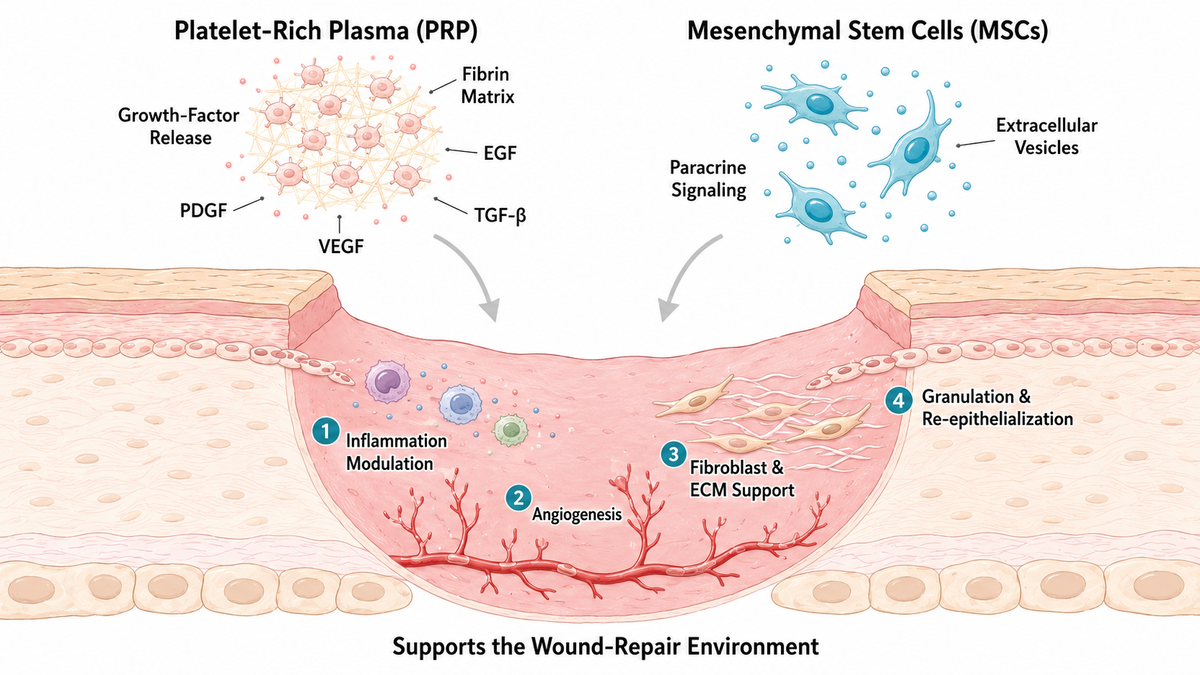
Platelet-rich plasma (PRP) and autologous mesenchymal stem cell (MSC) therapy are regenerative approaches that use the patient's own biological material to deliver concentrated healing signals to stalled wound tissue. China's regulatory framework allows broader clinical access to these treatments than the US or Europe, giving specialist centers accumulated experience that makes them a practical option rather than an experimental one.
PRP — concentrated platelet growth factors
PRP is made by drawing a small volume of the patient's blood, centrifuging it to concentrate the platelets, then applying or injecting the activated concentrate at the wound site. Platelets are the body's primary wound-healing signaling cells — releasing PDGF, VEGF, TGF-beta, and EGF when activated. In a stalled DFU, where the normal healing cascade has broken down, concentrated PRP delivers the signals the body should be producing but is not. Sessions take under an hour chairside; a typical course is 3–6 sessions weekly.
Autologous MSC therapy — stem cells for ischemic tissue
Mesenchymal stem cells harvested from the patient's own bone marrow or adipose tissue are concentrated in the hospital's cell-processing lab and injected into the ischemic foot tissue. MSCs release a broad spectrum of paracrine factors that reduce inflammation, stimulate angiogenesis, and recruit local repair cells — a profile particularly useful when revascularization is not technically feasible. Effects develop gradually; skin temperature, wound progress, and perfusion are assessed at 4-week intervals.
Evidence base
A 2019 meta-analysis in the Journal of Diabetes Research (10 RCTs, 442 patients) found PRP significantly improved complete wound closure rates (RR 1.22, 95% CI 1.03–1.44) versus standard care. Autologous MSC therapy has a smaller but growing evidence base — published series in Stem Cells Translational Medicine (2020) and Diabetes Care (2021) report limb-salvage improvements in patients with critical limb ischemia where revascularization was not possible. This is Level II–III evidence, reflecting outcomes in patients who had no other option.
Regulatory context
In the US, most MSC applications outside approved clinical trials are prohibited by FDA regulations. China's NMPA has taken a different path: since 2017, hospitals may apply for clinical-application approvals for cell therapies, allowing specialist centers to offer them as a clinical service within formal oversight. The result is accumulated real-world experience with both PRP and MSC therapy that Western centers operating under different rules cannot match.
In the US, most autologous MSC applications outside approved clinical trials are prohibited by FDA regulations. The EMA classifies cell-based products as ATMPs requiring full manufacturing authorization. Since 2017, China's NMPA allows hospitals to apply for clinical-application approvals for cell therapies, giving specialist centers the authority to offer MSC treatment as a clinical service. Partner hospitals have accumulated several years of real-world PRP and MSC experience that Western centers operating under different rules cannot match.
References
- Shen Y et al. Platelet-rich plasma for diabetic foot ulcers: a meta-analysis of randomized controlled trials. J Diabetes Res. 2019;2019:2710927.
- Carstens MH et al. Adipose-derived stromal vascular fraction (SVF) cells for the treatment of non-reconstructable peripheral arterial disease. Stem Cells Transl Med. 2020;9(12):1535-1544.
- Game FL et al. IWGDF guidance on use of interventions to enhance healing of chronic ulcers of the foot in diabetes. Diabetes Metab Res Rev. 2016;32(S1):75-83.
Doctors who perform this treatment
What does this cost?
All-in costs at China's specialist DFU centres — including inpatient stay, procedures, and coordination — are typically far lower than equivalent private care in the US, UK, or EU. Most patients self-pay; we also support insurance reimbursement documentation. We provide a transparent itemised estimate before you commit to anything, at no charge.
Request a free cost estimate →Free medical record review
Share your diabetic foot ulcer records for a free specialist review. Our care coordination team responds within 24–48 hours with an honest assessment.
This website provides medical-information science popularization only. It does NOT provide online diagnosis, prescriptions, or medical advice. Consult a licensed physician for any medical decision.